
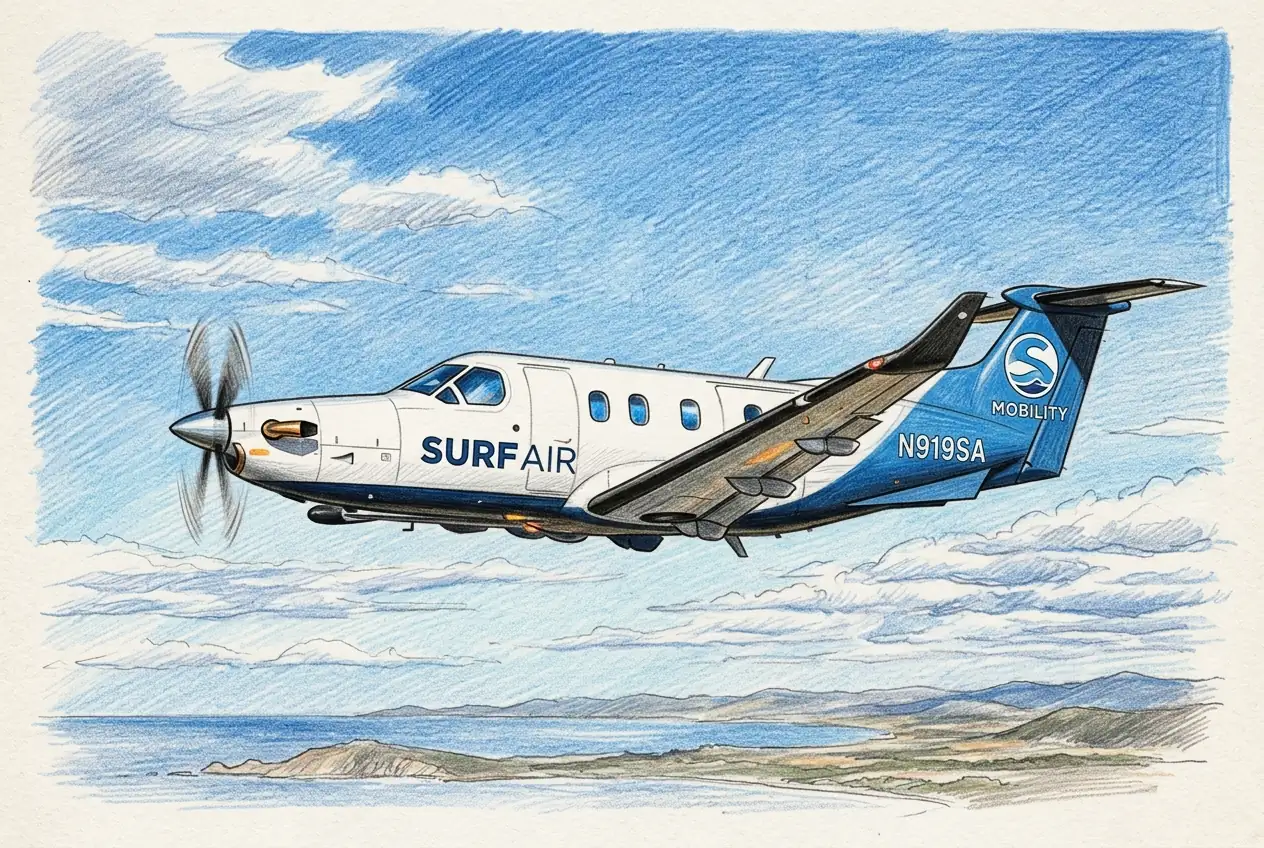
Shares of Surf Air Mobility (SRFM) jumped 7.75% to $1.29 on September 30 as the company stacked three software wins in rapid succession and installed a former Palantir executive to run its software unit. The moves mark a pivotal moment for a micro-cap airline trying to reinvent itself as a technology platform — but the economics deserve scrutiny.
Three Customers in Two Weeks Sounds Fast, But Revenue Is Still Unproven. Surf Air signed a definitive agreement with Air Fuga for its flight-operations management software, marking the third customer in less than two weeks.
The deal follows recent contracts with Sprintbach Aviation and SkyDance Air. The revenue model: Surf Air will earn a percentage of revenue for all flights managed through the software. That means income scales only if these small operators actually fly volume — there is no disclosed minimum commitment or contract value, making the near-term financial impact uncertain.
A Palantir Veteran Takes the Helm — Paid For With Stock. Barrett Brown spent over a decade at Palantir from 2013 to 2024, serving as Head of Asia since 2018. His hire lends credibility, but Palantir will receive 4,644,922 shares of Surf Air common stock as payment for continued access to Palantir software and services. With roughly 123.6 million shares outstanding , that issuance represents about 3.8% dilution — meaning existing shareholders are subsidizing the software partnership through ownership erosion rather than cash.
The Stock Has Nearly Doubled From Its Low, Yet the Company Is Still Burning Cash. SRFM traded as low as $0.88 on September 23 before the flurry of announcements pushed it to $1.29 — a 47% surge in five trading days. But context matters: Q2 2026 revenue was $29.5 million with an adjusted EBITDA loss of $10.5 million , and full-year 2026 revenue guidance sits at $128 million to $138 million . The company is forecast to remain unprofitable over the next three years .
The Palantir Brand Generates Buzz, But Surf Air Must Prove the Software Pays For Itself. The Palantir partnership includes forward-deployed engineering resources and joint business development, with Palantir supporting the commercialization of the flight-operations platform. That is real infrastructure backing — but the company is essentially trading equity for technology. At a market cap of roughly $160 million, every share issuance matters. Investors are betting that revenue-share contracts can eventually outweigh the dilution. Until those contracts generate measurable income, the rally runs on narrative, not numbers.