
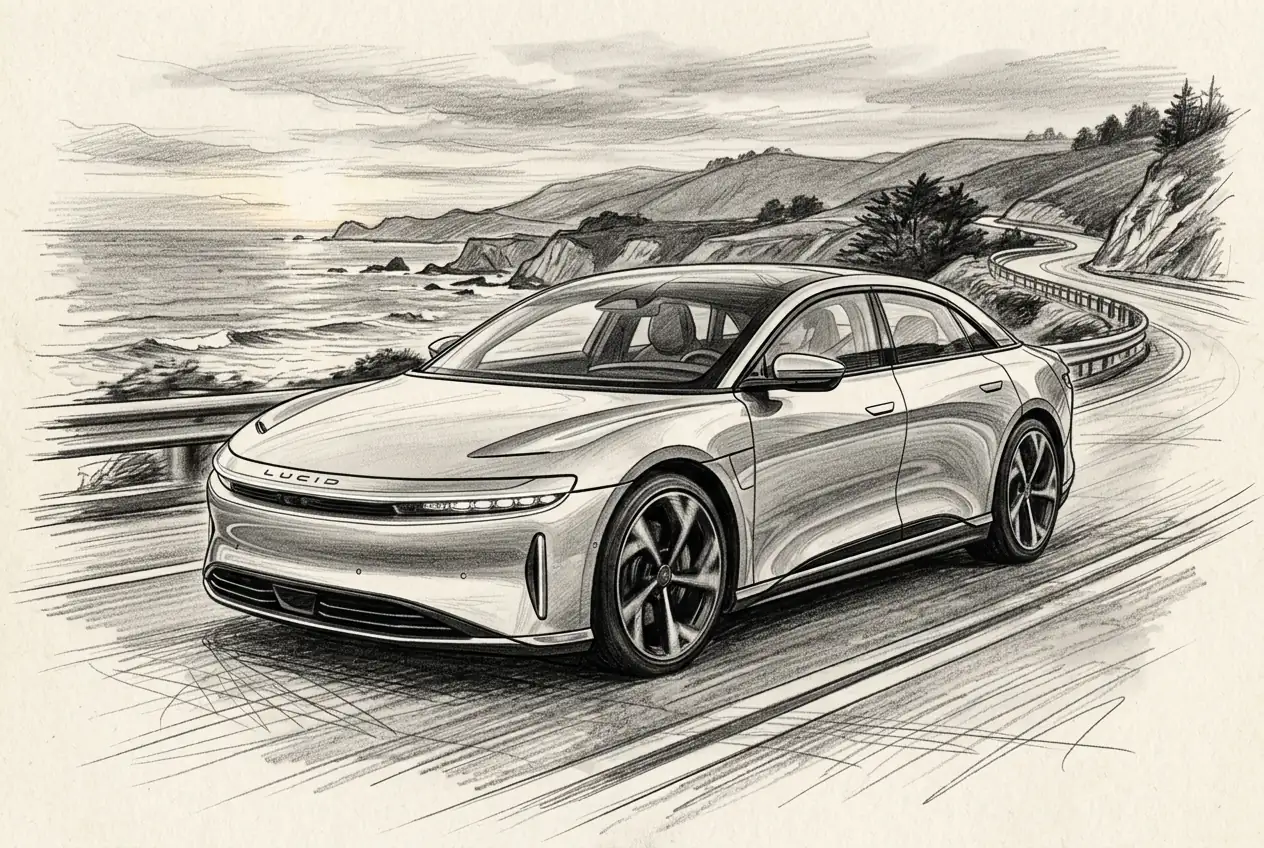
Shares of Lucid Group cratered as much as 13% after the EV maker reported Q2 2026 results that paired impressive revenue growth with staggering losses, a suspended production outlook, and a blunt admission from its new chief executive that the company has failed to execute.
The Numbers Look Worse Than Wall Street Feared
Lucid posted a loss of $3.30 per share versus the $2.46 loss analysts expected, on revenue of $405 million against a $416 million consensus.
Gross margin was a deeply negative -105%, driven partly by a $300 million inventory impairment — meaning Lucid spent more than twice its sales revenue just to build and write down the cars it sold.
The net loss topped $1 billion for the quarter, nearly doubling last year's $539 million loss. That math translates to roughly $253,000 lost per vehicle delivered — a figure that makes profitability feel theoretical.
A New CEO Admits the Old Playbook Failed
CEO Silvio Napoli, on his first earnings call, said Lucid has "not executed consistently," citing missed commitments, premature product launches, insufficient service investment, and organizational complexity.
He also disclosed the company is delaying its critical midsize vehicle — likely pushing it to the second half of 2027 — the lower-priced model many investors viewed as the catalyst for reaching meaningful scale.
Cutting to Survive, Not to Grow
Lucid slashed its U.S. workforce by 20%, eliminated the second shift at its Arizona factory, and generated $115 million in annualized savings as part of a broader $1.4 billion cash-flow improvement program for 2026.
No formal guidance was provided; management warned Q3 and Q4 production will fall below Q2 levels. For investors, the absence of a production target erases visibility into when — or whether — unit economics improve.
The Saudi Lifeline Buys Time, Not Certainty
Lucid ended Q2 with $3.0 billion in total liquidity, including $2.2 billion in credit facilities.
Its largest shareholder remains Saudi Arabia's Public Investment Fund , and Prince Alwaleed recently disclosed a separate 5% stake. That sovereign backing reduces near-term bankruptcy risk, but at the current cash-burn rate, liquidity extends only "well into 2027" — meaning another capital raise is likely before scale-up economics can take hold.