
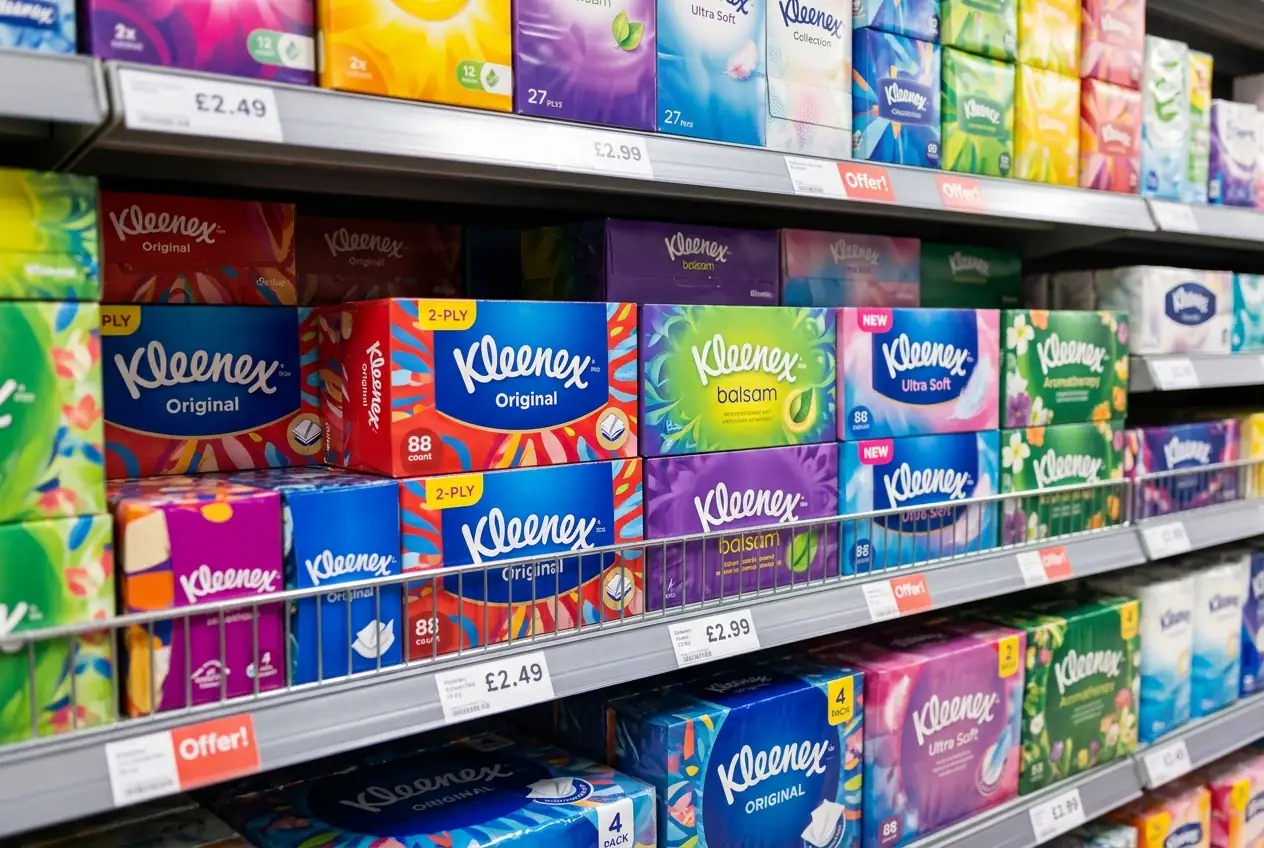
Shares of Kimberly-Clark plunged 9.7% to $100.52 on August 25, as renewed fears over financing, dilution, and integration risks from its mammoth Kenvue acquisition hammered the stock on an otherwise firm market day. The sell-off underscores a stark reality: even after shareholders cleared the deal months ago, Wall Street remains deeply skeptical that the 153-year-old tissue-and-diaper maker can pull off one of the largest consumer-products mergers in recent memory.
The Sheer Size of the Deal Dwarfs the Company Itself
Kimberly-Clark is paying $48.7 billion for Kenvue — the maker of Tylenol, Band-Aid, and Listerine — offering Kenvue holders $21.01 per share, a roughly 46% premium to the pre-deal price.
The cash-and-stock structure requires $6.7 billion in cash and roughly 280 million new shares, nearly doubling KMB's share count from the 331.9 million outstanding before the deal. That means existing shareholders will see their slice of the company cut almost in half.
Debt Is Already Heavy — and About to Get Heavier
Kimberly-Clark carried $7.2 billion of debt at year-end 2025 and expects to add acquisition financing and potentially assume or refinance Kenvue debt, leaving the combined company with "substantially more indebtedness and reduced financial flexibility."
Debt-to-equity already stands at 373.7% as of June 30, 2026, and the current ratio sits at 0.9x — below the threshold that typically signals comfortable short-term liquidity.
Management is targeting roughly 2.0x net leverage within 24 months post-close , a goal that looks ambitious given the numbers.
Earnings Will Take a Hit Before Synergies Arrive
Management itself guided that the deal would cause "no more than mid-single-digit EPS dilution" in year one — cold comfort when Kimberly-Clark has already lowered its full-year earnings outlook due to disruptions in its China diaper business and now expects adjusted EPS to decline at a low-single-digit rate. The promised $2.1 billion in annual cost savings is the carrot, but if integration costs run hotter than expected — or if Kenvue's underlying business continues to underperform after missing Q2 2026 estimates — the combined entity's debt-servicing capacity will face scrutiny.
The Ownership Math Tells the Real Story
After close, current KMB holders will own roughly 54% and Kenvue holders roughly 46% of the combined company.
The merged entity is projected to generate about $32 billion in revenue and $7 billion in adjusted EBITDA. Investors are being asked to accept near-term pain — diluted earnings, ballooning debt, execution risk — for a long-term portfolio that may or may not deliver growth Kimberly-Clark has struggled to find on its own.