
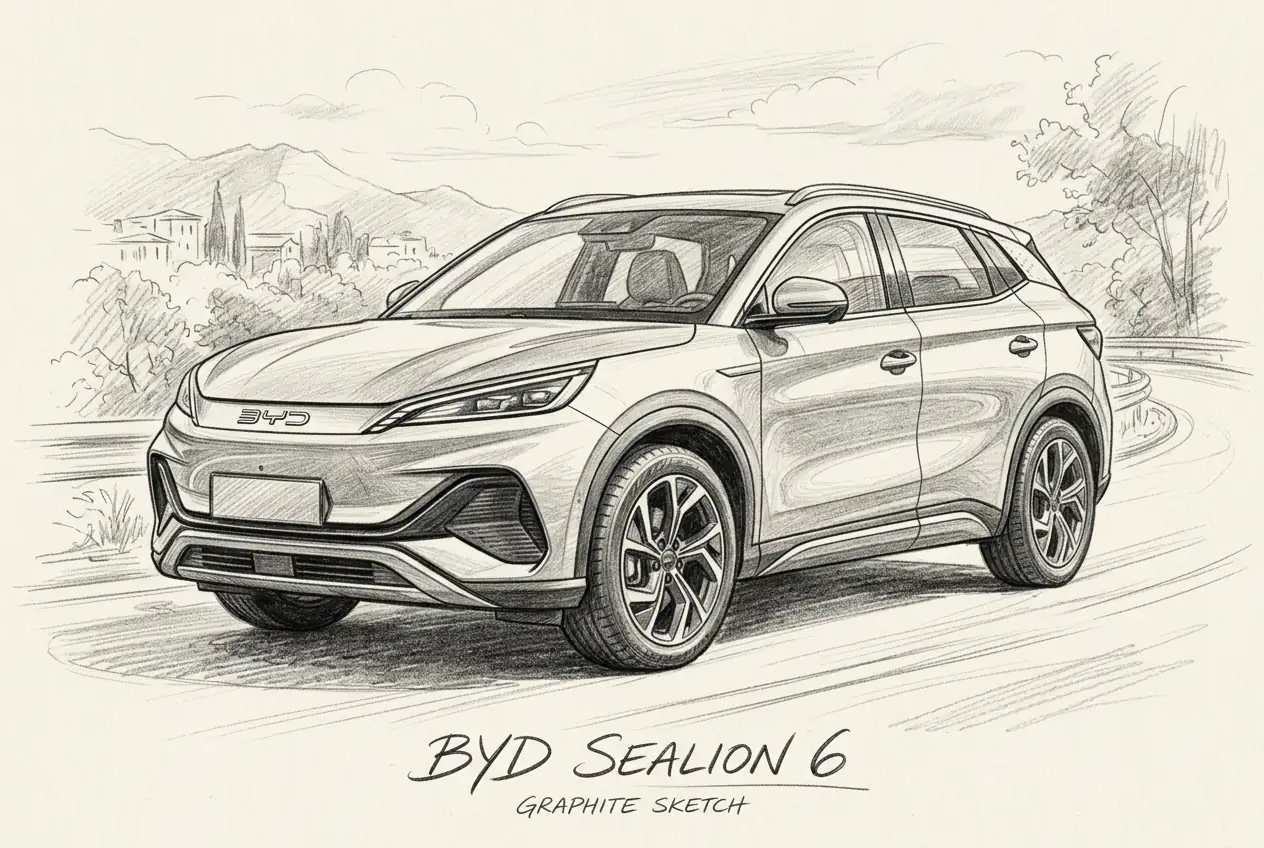
Shares of BYD slid roughly 10.7% over five sessions to $78.20, as investors digested the company's decision to launch its Sealion 6 plug-in hybrid SUV in South Korea at prices that undercut local rivals by a wide margin. BYD's $24,000 Hybrid SUV Invades Hyundai's Home Turf — Can Volume Growth Justify Shrinking Profits?
Shares slid as BYD launched its first plug-in hybrid SUV in South Korea at a price that undercuts the home team, extending a five-session selloff that has lopped 10.7% off the stock. The move crystallizes the central tension facing BYD shareholders: the world's largest EV maker is winning global market share at a pace that is eroding, not expanding, its bottom line.
A Price Tag That Puts Hyundai on Notice. BYD began pre-orders for the SUV on June 26 at the Busan Mobility Show, starting at 37.5 million won (~$24,430).
The Hyundai Tucson Hybrid — the closest local competitor — starts at 34.2 million won in South Korea. But BYD's vehicle is a plug-in hybrid with roughly 70 km of pure-electric range, a category that typically commands a steep premium. Aggressive pricing from BYD is already intensifying pressure on South Korea's domestic automakers.
Volume Is Surging, but Profits Are Going the Other Way. BYD crossed 2,000 monthly sales in South Korea for the first time in April, up 272.6% year-over-year.
It reached 10,000 cumulative sales in just 11 months — the fastest pace ever for an imported brand in Korea. Yet this growth comes amid a bruising global price war. Q1 2026 net income plunged 55% to 4.08 billion yuan ($597 million) while revenue fell 12%.
Four straight quarters of declining profit reflect price cuts that hit a two-year peak in March.
Overseas Sales Are the Lifeline — If Margins Follow. Goldman Sachs noted BYD's Q1 operating profit beat expectations by 82%, with overseas sales jumping from 21% to 46% of total volume.
Overseas markets carry higher profit margins than the domestic market. But analysts caution that registrations don't automatically translate into profits — building out logistics, dealer networks and marketing abroad comes with heavy upfront costs.
The Stock Reflects Skepticism, Not the Sales Story. BYD's shares are "caught between a globally ambitious product offensive and a market that wants more than just volume."
The company raised its 2026 overseas target to 1.5 million vehicles, up from 1.3 million. South Korea, where hybrid acceptance is high, is a logical beachhead. But until BYD proves that aggressive international pricing can eventually produce fatter per-vehicle profits — not just bigger delivery numbers — the stock is likely to trade on earnings, not ambition.